
Platform
The integrity layer that flags cheating signals in the hiring process
Science-backed hiring integrity built into the Hirevue platform
Application fraud is increasing.

50%
of candidates used AI during the application process.
1 in 4
candidate profiles worldwide will be fake by 2028.
70%
of managers call hiring fraud an underestimated financial risk.
How it works
One integrity layer. Every hiring touchpoint.
Fraud detection connects identity, environment, behavior, and response signals to verify candidates and their work. Start transparently, add role-appropriate checks, and keep the experience clear for authentic candidates.


Set clear expectations
Explain the identity, environment, audio, screen, and browser checks before the interview begins, so candidates know exactly what to expect.
Maintain continuity
Confirm the same person remains present throughout the process. Use candidate snapshots and automated flags for browser-focus loss or unexpected session changes.
Review the full picture
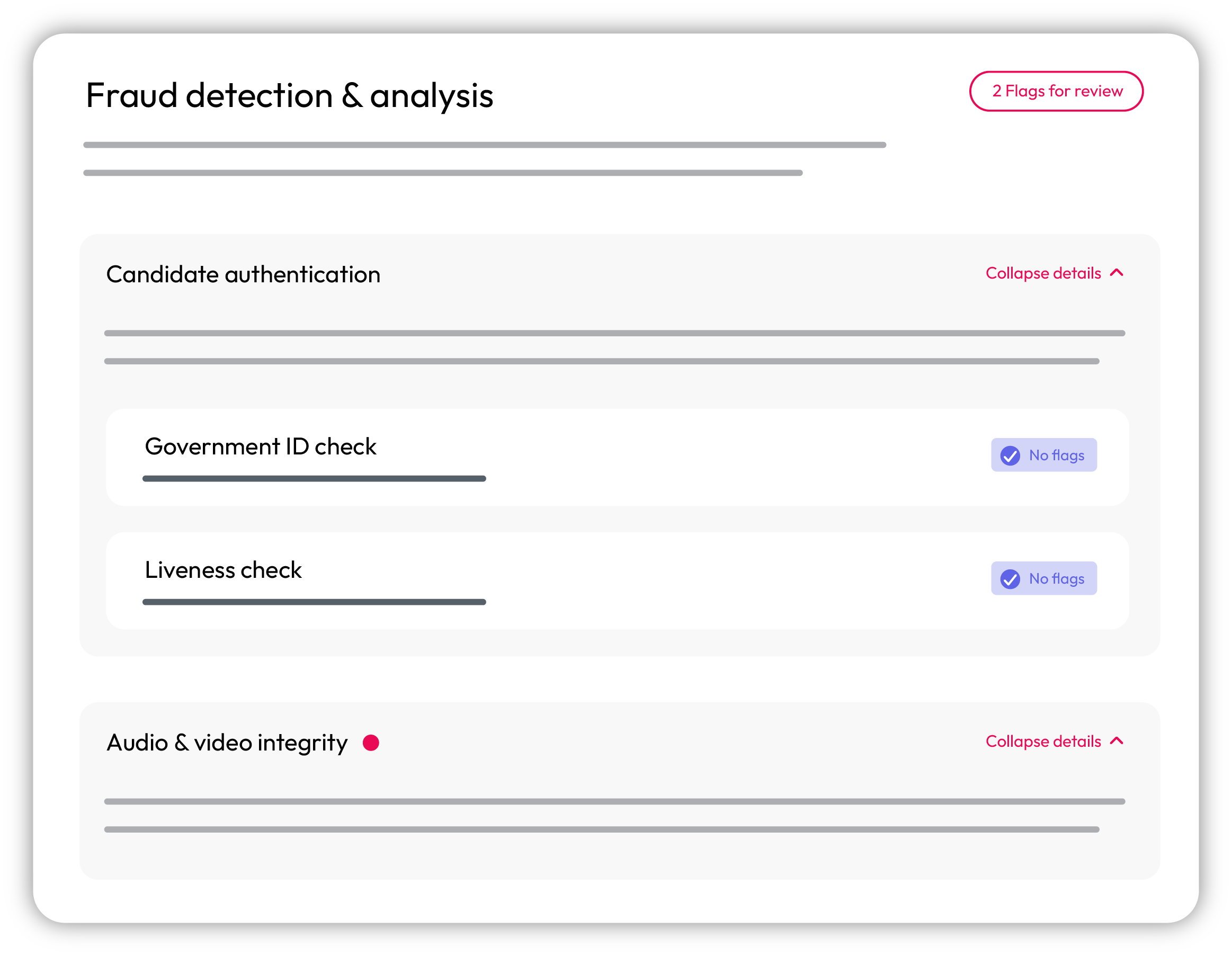
Bring fraud indicators, candidate performance, and interviewer context into one report. Show reviewers the underlying evidence, so they can decide what needs follow-up.
Why it is better
Balancing candidate friction with verification
Standalone tools
Hirevue
Coverage
One step in the process
Assessments and interviews
Signals
Isolated flags
Connected evidence
Controls
One-size-fits-all
Configured by role risk
Candidate impact
Friction for everyone
Clear, proportional checks
Decision support
A pass-or-fail alert
Context and an audit trail
Mature enterprise-ready solution with feature depth

Loss of focus

Location signals

Identity continuity

Browser monitoring

Disabling paste

Candidate transparency

ID verification

Fraud reporting

Integrity works better when the whole system works together.
Audit-ready platform with advanced scheduling and cheating mitigation

 Schedule
Automate
Permissions
Schedule
Automate
Permissions
 Reliable
Valid
Fairer
Reliable
Valid
Fairer
 ATS
HRIS
LMS
ATS
HRIS
LMS
 SOC
ISO
FedRamp
SOC
ISO
FedRamp
 Fraud
Cheating
Audits
Fraud
Cheating
Audits
 Pro Services
Customer Success
Pro Services
Customer Success
Enriches 45+ ATSs





Every signal, verified.
Every decision, confident.
Frequently asked questions
Candidate fraud happens when a job applicant intentionally misrepresents their identity, qualifications, experience, location, or abilities during the hiring process. A deepfake interview involves using AI-generated or altered video or audio to impersonate a candidate during an interview. It can include fake or stolen identities, falsified credentials, proxy candidates, deepfakes, or other deceptive tactics designed to make someone appear to be a different or more qualified candidate.
Job application fraud is deceptive activity that begins at the application stage, such as submitting false qualifications, fabricated work experience, synthetic identities, stolen personal information, or misleading application materials. Generative AI can make this type of fraud easier to scale, making it more important for employers to validate candidate identity and skills beyond the resume.
Hiring fraud can take several forms, including candidate impersonation and fake candidates, synthetic or stolen identities, falsified qualifications or employment history, location misrepresentation, AI interview cheating, proxy interviewing, deepfake interviews, and intentionally fraudulent AI-generated applications. It can occur anywhere from the initial application through interviews, assessments, onboarding, and even after hire.
Candidate cheating typically involves misrepresenting a person’s skills or abilities—for example, using unauthorized assistance to answer an assessment or interview question. Candidate fraud goes further by misrepresenting who the person is or a fundamental part of their identity, experience, qualifications, or intent. Both can undermine hiring integrity, but fraud can also create broader security, financial, and compliance risks.
Not necessarily. Using AI to improve wording, organize experience, or prepare for an application does not automatically make an application fraudulent. The issue arises when AI is used to fabricate qualifications, experience, identities, or capabilities that the candidate does not actually have. Employers need hiring processes that distinguish polished applications from demonstrated, job-relevant skills.
Interview fraud detection works best as a layered approach rather than relying on a single signal. Employers can combine structured assessments and interviews with candidate conduct policies, behavioral indicators, identity checks where appropriate, consistent skills validation, and human review to identify activity that may require closer investigation.
Hirevue helps organizations protect hiring integrity with tools designed to discourage dishonest behavior and surface signals for recruiter review. Capabilities include configurable candidate conduct policies, browser-focus tracking, controls that limit copy-and-paste behavior, and image capture during eligible OnDemand hiring experiences. Together, these signals provide hiring teams with more context while allowing candidates to demonstrate their abilities authentically.
Hirevue provides hiring teams with signals and information that can help identify behavior that may warrant additional review. A single behavior should not automatically be treated as proof of fraud. The goal is to give employers greater visibility into the hiring process while keeping people involved in decisions about how those signals should be interpreted.
The strongest fraud prevention strategies introduce the right level of verification without treating every candidate like a bad actor. Clear expectations, transparent candidate conduct policies, targeted integrity controls, structured interviews, and job-relevant assessments can protect the hiring process while keeping the experience straightforward for legitimate candidates.
Resumes and applications are becoming easier to generate and optimize with AI, making it harder to determine what a candidate can actually do based on application materials alone. Structured interviews, assessments, and job simulations give candidates an opportunity to demonstrate job-relevant capabilities, helping employers validate skills instead of relying only on how convincing an application appears.