
PLATFORM
Better hiring science means better hiring results.
One thread. Every product. Validated science throughout the hiring process.

1,300+
Validation studies for accuracy
2,000+
Calibration and fairness studies
75+
Peer-reviewed publications
20+
Years of I-O psych experience
250M
Assessments and interviews complete
Automation without validation is a liability.
Decisions based on science are more predictive and defensible.
Tech-only vendors
Hirevue
Focus
Features with unknown value (e.g., avatars)
Measuring improved outcomes (e.g., quality of hire and retention)
Value
Fast decisions
Accurate decision support at enterprise scale
Platform
Experience only
Experience + support on what and how to ask (content)
Process
Fully flexible
Customization inside a best practice framework
Compliance
Recruiter trust. Undocumented AI behavior.
Governed process. Legally defensible on published proof.
Improved performance, retention, and fairness from 250M+ interviews and assessments complete
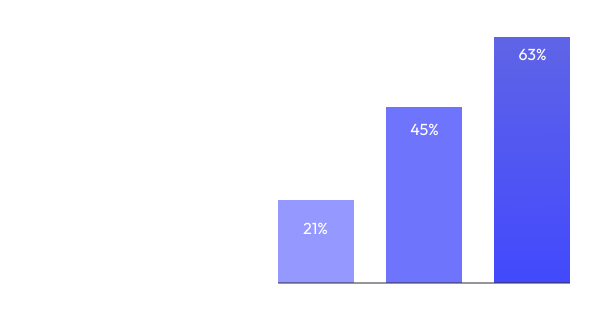
Quality of hire impact in early careers / graduate
+3x
Candidates who score high are more than 3x as likely to receive high overall performance ratings.
Overall performance rating
New hire retention % over 180 days
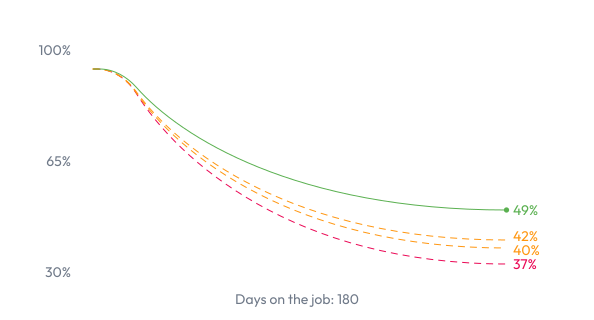
Retention Impact in retail
+33%
Difference in retention between best and worst-fit candidates (based on nearly 1M retail associate hires)
Ethics and compliance
Industry-leading AI ethics and defensible compliance
01
AI Informs.
Humans decide.
Every score helps inform recruiter decisions.
Candidates can opt out.
Recruiters always make the final call.
02
Validated before deployed
Reviewed for fairness before deployment
Annual independent audits
Ongoing monitoring
03
Explainable, not a black box
AI Interviewer scores tied to behavioral anchors (BARS)
Rigorous explainability statement
Grounded in evidence not opaque predictions
04
Transparent to all stakeholders
Candidates grant AI consent
Legal gets audit docs
IT gets full AI disclosure
How it works: Different types of hiring science tests at multiple steps, not just at the end
Governed controls
Does it stay within approved boundaries?

science framework


Identifies job relevance
Does it identify job-relevant skills that actually matter?
Validity of evaluation
Does it evaluate evidence accurately?
Reliability of interaction
Does it gather evidence safely and consistently?
AI Interviewer example: Conduct rigorous validation studies on sub-agent performance

Job relevance
→ Job description-to-script agent
Our research shows that the agent understands what matters for the job, asks the right questions, and catches questions that might be unfair.


Reliability of interaction
→ Conversation agent
Rigorous testing to ensure agent interviews are conducted consistently and fairly across candidates

Validity of evaluation
→ Scoring agent
Tested to ensure scores are generated consistently across candidates

Governed controls
→ Guardrail agent
Rigorously tested controls in place to ensure agent follows the rules, records what it does, and continues working correctly when the system changes
Want to learn more about our standards and principles?
Ethical AI principles
Measuring the impact of software
AI Explainability Statement
Transforming the way organizations discover, engage, and hire the best talent
Diversity
We put the human back into human resources
Don’t guess. Validate.
Frequently asked questions
Hirevue evaluates candidates using job-relevant skills, behaviors, and competencies defined for a specific role. Depending on the solution, candidates may complete structured interviews, assessments, or job simulations designed to measure those capabilities consistently. Evaluation criteria are established for the role rather than applying one universal Hirevue score to every candidate.
Hirevue’s AI evaluates candidate responses against job-related competencies and defined evaluation criteria. For AI-scored video assessments, Hirevue analyzes the transcript of what a candidate says—not facial expressions, body language, appearance, background, or tone of voice. The goal is to provide recruiters with structured, job-relevant information to support hiring decisions.
No. Hirevue does not use facial analysis to evaluate candidates in its assessments. AI-scored responses are based on the content of a candidate’s answer and its relationship to relevant job competencies—not facial expressions, body language, appearance, or other visual characteristics.
Hirevue’s science team includes I-O Psychologists and Data Scientists who evaluate assessment models for job relevance, consistency, and potential demographic differences. Models are tested before deployment and monitored over time, with additional oversight provided through documented AI governance practices and independent audits.
Hirevue applies established principles from I-O Psychology, psychometrics, and data science to determine whether assessments measure job-relevant capabilities and support meaningful hiring decisions. Assessments and models are tested and validated before deployment, with ongoing monitoring designed to maintain consistent and defensible results.
Hirevue uses integrity and fraud-detection measures appropriate to different assessment and interviewing experiences. These may include signals that help identify potentially suspicious activity or inconsistencies for further review. Rather than treating a single signal as automatic proof of cheating, these tools are designed to give hiring teams additional information they can evaluate as part of the broader hiring process.
Hiring science applies research, data, and established principles from fields such as I-O Psychology and psychometrics to understand which candidate characteristics are relevant to success in a role. It helps organizations move beyond subjective hiring signals by creating structured, job-relevant ways to evaluate skills and competencies.
Structured hiring helps create a more consistent process by evaluating candidates against the same job-relevant criteria. Hirevue combines structured assessments with testing and monitoring designed to identify potential demographic differences, helping organizations make decisions based more on demonstrated skills and competencies and less on subjective signals.
No. Hirevue’s AI is designed to support human decision-making, not replace it. AI can help organizations evaluate job-relevant information consistently and give recruiters structured insights, while employers remain responsible for determining how those insights are used and for making hiring decisions.
Hirevue’s I-O Psychologists apply research on human behavior, work, measurement, and assessment to the hiring process. They help identify job-relevant competencies, develop and validate assessments, evaluate fairness, and ensure hiring technology is grounded in established scientific principles rather than relying only on technical capabilities.