
Candidate Experience: The Good, The Bad, The Ugly

The Talent Board just released their 2016 Candidate Experience Research Report, and with it comes some phenomenal new insight into the way organizations are treating their most lucrative candidates. So let’s kick this off with a bit of background: It’s been three years since Virgin Media’s “Rejected Candidate Survey” revealed $5 million in lost revenue as the result of a terrible candidate experience. That survey was a wake-up call for companies to fix their cumbersome job applications. Nowadays, the job hunting process couldn’t be simpler and more convenient – a stress-free experience for both candidates and employers. Just kidding. It got worse. Courtesy of the 2016 Candidate Experience Research Report, we now know the latest nitty-gritty details regarding the state of candidate experience. Like so many revealing statistics, these findings can be conveniently grouped as “Good”, “Bad”, and “Ugly”. Unfortunately, most of them are Bad and Ugly. In this article we’ll examine what went well, what went wrong, and what we can do about it.
The Good, The Bad, The Ugly
The Good
Before jumping into the painful experiences of job hunters everywhere, let’s look at what we’re doing right.  Mobile-enabled job applications experienced a huge increase in adoption in 2016. Where in 2015 only 18% of employers offered a mobile-enabled application, 2016 saw that number skyrocket to 79%. That’s a massive increase, and something every employer should be proud of. Also up from the previous year is the use of in-application progress meters. While only 18% of candidates could view a progress meter in 2015, that number jumped to 61% in 2016. Why this number isn’t bordering 100% is baffling – but at least we’re getting better.
The Bad
Now time for the bad. As we’ll see, the candidate experience still leaves much to be desired.  Only 31% of candidates surveyed said they would reapply to the job they most recently applied for. This is down from 2015, when 37% indicated they would be willing to reapply. The number of interviews candidates experience is also increasing. Only 65% of candidates experienced 1-2 interviews in 2016, down from 79% in 2015. Putting candidates through a (seemingly) arbitrary number of interviews is discouraging, stressful, and a poor experience all around.
The Ugly
Now the ugly: 47% of candidates (nearly half) were still waiting to hear back from employers more than two months after they applied.  Since at this point it is unlikely they will ever hear back, it would not be a stretch to say that half of all candidates still haven’t heard from these organizations to this day. Turning your application process into a digital black hole is a sure-fire way to gain the disdain of your candidates. Winning back the trust of candidates treated this way is a monumental effort, and it is much easier to tackle the problem at its root before it gets out of hand.
Should You Invest In Candidate Experience?
For many organizations, candidate experience ranks among the “nice to have” rather than the “need to have.” Would it be nice to make the job application process as convenient and seamless as possible for candidates? Sure. No one thinks a poor application experience is a good thing to have – and in the age of social media and Glassdoor, we know that a good candidate experience has the ability to attract the best talent by reputation alone (75% of candidates now conduct their own research online). At the end of the day, “great candidate experience” is a somewhat ambiguous goal. As a result, priorities like talent retention, engagement, and direct recruiting efforts are put ahead of the more ambiguous “great candidate experience.” It’s also harder to convince business lines that this matters. We know it does in HR, but business doesn’t always align with importance. But for all its ambiguity, we shouldn’t give up on its relentless pursuit. Why? Because…
Your Application is Your Brand
Candidates don’t apply to open positions blindly (usually). If the application process is a horrible experience, they know exactly who is putting them through it.  Look – this isn’t new data, and chances are you’re already familiar with the increasingly blurred line between the marketing and recruitment function. When candidates feel slighted by a terrible application experience, they are not afraid to take their grievances public through Twitter or Facebook. And as this latest Candidate Experience Research Report details, 41% of job seekers who rate their application experience as “one star” will take their business elsewhere. For large organizations (like Virgin Media), this can equate to millions in lost revenue. On the flip side, 64% of job seekers who give their application experience five stars actively intend on increasing their relationship with the employer – whether or not they get the job. For any organization, this can equate to millions in gained revenue.
Your Application Influences Who Applies
Losing top talent to competitors is a huge (if difficult to precisely quantify) opportunity cost. Not only do your business rivals gain a competitive advantage by acquiring the best talent, they force your organization to settle for less than the best. Offering a poor candidate experience hobbles your recruitment efforts before the race even begins. Remember how 75% of candidates conduct their own job-related research online? Sites like Glassdoor make it easy to gather data and omit poor experience providers from the job hunt. This is not to say you can’t have a huge applicant pool with a terrible candidate experience – but you’ll never know who avoided the application entirely. Think about it this way: the candidates that can afford to exclude your organization from their application checklist are the candidates you can’t afford to miss out on.
The candidates that can afford to exclude your organization from their application checklist are the candidates you can’t afford to miss.
Building a Better Candidate Experience
Creating a better candidate experience starts with putting yourself in the candidate’s shoes. If you’ve been off the job market for awhile, this can be difficult – it’s easy to lose touch with the current candidate’s plight if you haven’t applied in years. Start by taking your own application. Is it missing something as simple as a visible progress meter? Is it optimized for mobile? If you’re willing to go deeper, create multiple “personas” to take the application – and see how long it takes to hear from talent acquisition. If you’ve done that, ask yourself what Net Promoter Score you would give your organization. I know it’s tough to be objective in this situation, but do your best to avoid bias. Now get the rest of your team to take the application. Have an honest talk about what would make the experience better.
Video Interviewing Rated Higher Than All Interviewing Combined
Video interviewing isn’t just a great way to increase hiring quality and speed. It’s also incredibly well received by candidates: those that experienced video interviews rated them higher than all interviewing combined (3.84 vs 3.75 out of 5). 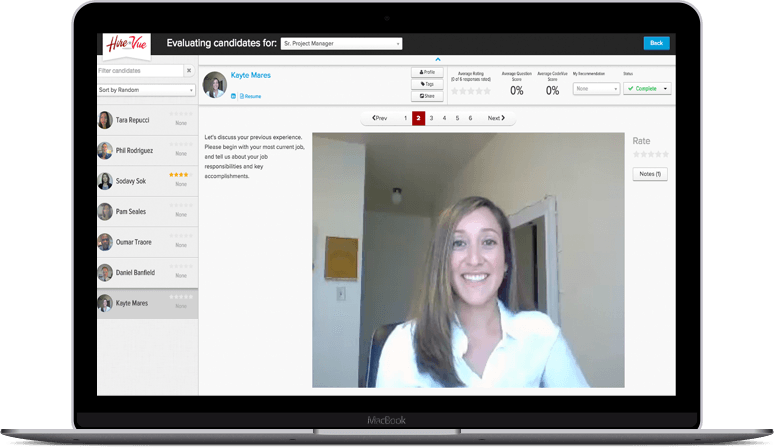 If case studies are more your thing, Urban Outfitters boosted their NPS to almost 3x that of the retail average. And it isn’t only retailers who experience these sorts of results: TMX Finance’s NPS rocketed to over 80, and Delta Airlines boasts a phenomenal NPS of 85. All make use of on demand video interviewing to build a better candidate experience. And if you’d like to hear from the candidates (and recruiters) themselves, check out this page. But more important than adopting tech solutions is making real change – and that can only come from feedback.
The Importance of Feedback
Asking for feedback is not only a great way to improve the candidate experience, it also acts as a crucial tool for evaluating your candidate experience-related efforts. Without candidate feedback, you’ll have no way of evaluating and tuning your chosen solution(s) to their needs. And after a few months have past, put yourself in the candidates’ shoes and go through your application process again. Compare this iteration to those previous and reflect on what improved – and what could still be better. Rome wasn’t built in a day, after all.
Stats to Reflect On
We’ve referenced a lot of statistics through the course of this article, courtesy of the 2016 Candidate Experience Research Report. For quick reference and reflection, here are some of the most relevant:
- 75% of candidates conduct their own job-related research online.
- 31% of candidates said they would reapply to the job they most recently applied for (down from 37% in 2015).
- 61% of candidates could view a progress indicator displaying application percentage completed (up from 18% in 2015).
- 79% of employers offer application via mobile (up from 18% in 2015).
- 47% of candidates still waiting to hear back from employers more than two months after they applied.
- 41% of job seekers giving their experience a one-star rating will take their business elsewhere.
- 64% who give their experience five stars will increase their relationship with the employer.
- 65% of candidates experience 1-2 interviews (down from 79% in 2015).
Candidates that experience video interviews rate them higher (3.84 vs 3.75 out of 5) than all interviewing combined.
Wrapping Up
Video interviewing is a strong step toward building a great candidate experience, but it is not the only step. Building a great candidate experience takes time, effort, and research. For greater insight into what makes a candidate experience truly phenomenal, download Talent Board’s 2016 Candidate Experience Research Report.