The new era of retail and manufacturing hiring: From faster to smarter

For years, high-volume hiring has been defined by one metric: speed.
Retailers needed associates on the floor before peak season. Manufacturers needed workers on production lines to meet demand. Recruiting teams were measured by how quickly they could fill open roles and keep operations running.
Today, the challenge looks very different.
Organizations are receiving more applications than ever before, yet identifying qualified talent has become increasingly difficult. AI-generated resumes, one-click applications, and crowded talent pipelines have created a new reality where candidate volume is abundant, but meaningful hiring signals are harder to find.
At the same time, labor shortages, turnover, and rising candidate expectations continue to put pressure on hiring teams. Employers need to move quickly to secure talent, but they can’t afford the cost of making the wrong hiring decision.
The future of retail and manufacturing hiring isn’t simply about hiring faster.
It’s about hiring smarter.
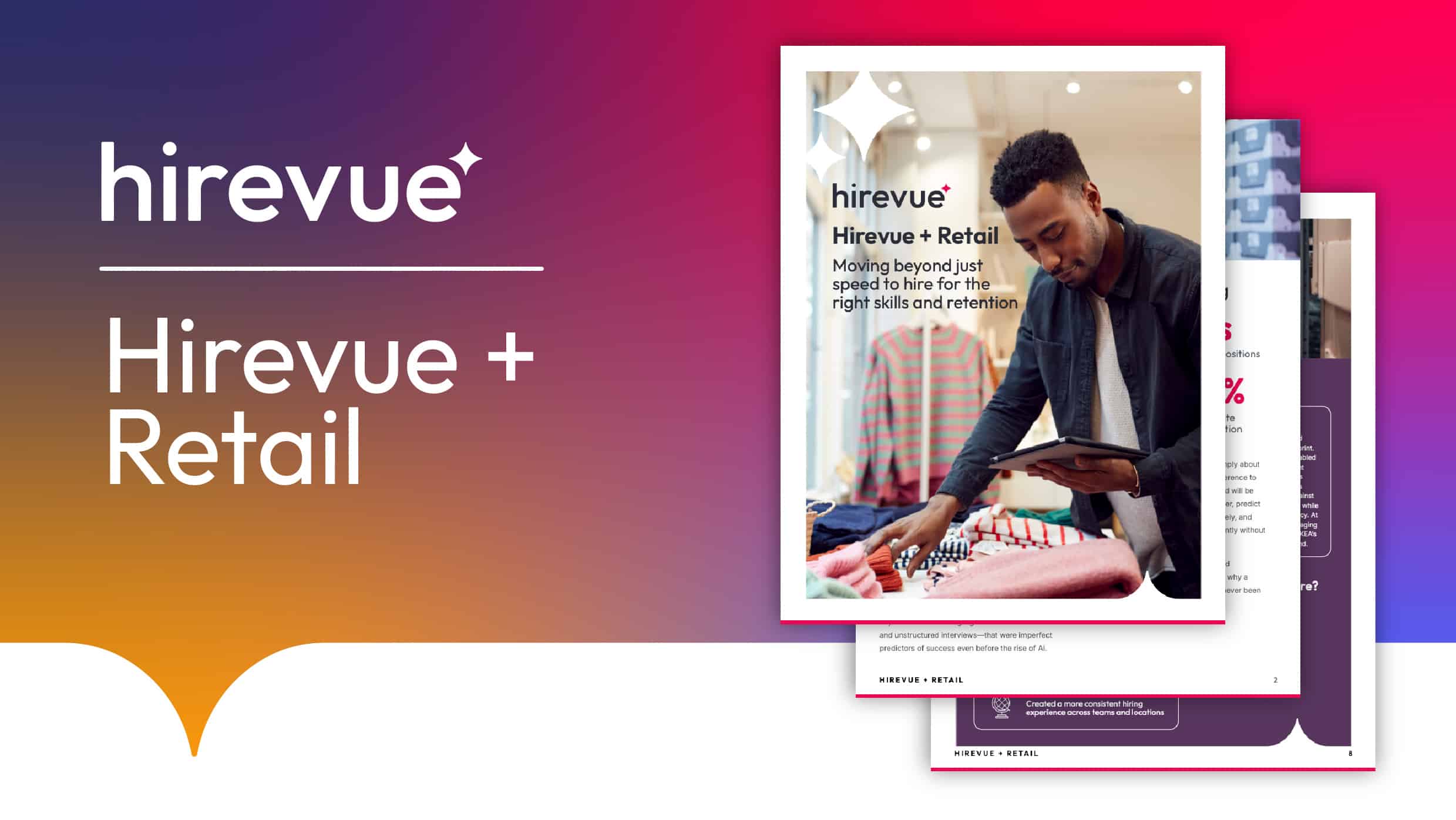
Download the retail hiring guide and learn how teams are using Hirevue.
The new reality of high-volume hiring
More applications should make hiring easier, but instead, many organizations are finding the opposite.
Research shows that the majority of applicants for high-volume roles are ultimately deemed unqualified by hiring teams. Meanwhile, AI-assisted applications have made candidates look increasingly similar on paper, making it harder to identify the skills that actually predict success on the job.
The result is a growing disconnect between hiring volume and hiring quality.
Recruiters spend more time screening candidates. Hiring managers face larger candidate pools with less meaningful information. And organizations struggle to confidently identify who is most likely to succeed, stay, and perform.
For retailers and manufacturers already operating with lean teams, the consequences are significant:
- Longer hiring cycles
- Increased recruiter workload
- Higher turnover
- Greater compliance risk
- Rising costs associated with mis-hires
Simply accelerating the process is no longer enough.
Organizations need better ways to identify talent earlier and make more confident hiring decisions.
Why turnover remains the biggest cost of hiring
Filling an open role is only half the battle.
Keeping employees engaged and productive after they’re hired is often the greater challenge.
Retail organizations continue to face significant turnover rates, creating an expensive cycle of recruiting, onboarding, training, and rehiring. Manufacturing organizations face similar issues, particularly in warehouse, production, and frontline operations where workforce stability directly impacts productivity and operational efficiency.
Every departure creates ripple effects:
- Lost productivity
- Additional recruiting costs
- Increased training expenses
- Greater strain on existing employees
- Disruptions to customer and operational outcomes
The most successful organizations recognize that retention starts before an employee’s first day.
By understanding candidate fit, motivation, and job readiness earlier in the hiring process, employers can make decisions that improve both quality of hire and long-term retention.
Consistency is now the competitive advantage
Retailers with thousands of stores and manufacturers operating across multiple facilities face another growing challenge: consistency.
When hiring practices vary by location, team, or manager, organizations introduce risk into the hiring process.
Different interview styles, evaluation criteria, and screening methods can lead to inconsistent hiring outcomes, compliance risks, uneven workforce quality, and variable candidate experiences.
The challenge becomes even greater at scale.
Leading organizations are increasingly adopting structured, standardized hiring approaches that ensure every candidate is evaluated against the same job-relevant criteria, regardless of location or hiring manager.
Consistency doesn’t just improve fairness.
It improves business outcomes.
Seasonal hiring demands new approaches
The pressure intensifies during seasonal hiring periods.
Retailers preparing for peak shopping seasons and manufacturers ramping up production often need to hire thousands of workers in a matter of weeks.
Traditional hiring methods struggle to keep pace with this demand.
Manual screening, phone interviews, scheduling coordination, and fragmented hiring systems create bottlenecks that slow decision-making and cause employers to lose qualified candidates to competitors.
The organizations that succeed during hiring surges are those that can:
- Scale hiring without increasing headcount
- Reduce administrative burden
- Quickly identify qualified candidates
- Deliver seamless candidate experiences
- Maintain consistency at high volume
Achieving all of this requires more than automation. It requires intelligence throughout the hiring process.
Moving from inference to evidence
For decades, hiring decisions have relied heavily on resumes, interviews, and intuition.
But resumes often tell employers what candidates claim they can do—not what they can actually do.
The organizations gaining an advantage today are shifting from inference to evidence.
Instead of relying solely on traditional hiring signals, they are using validated assessments, structured interviews, realistic job previews, and AI-powered screening tools to identify demonstrated skills, capabilities, and potential earlier in the hiring process.
This approach enables hiring teams to:
- Identify quality talent faster
- Improve hiring consistency
- Predict retention and job fit
- Reduce turnover
- Enhance candidate experience
- Scale hiring efficiently
Most importantly, it allows organizations to make decisions based on objective evidence rather than assumptions.
Moving from fast hiring to fast, quality hiring
Retail and manufacturing hiring is entering a new era.
Candidate volume is growing. Hiring complexity is increasing. AI is changing how people apply for jobs. And recruiting teams are being asked to accomplish more with fewer resources.
The organizations that thrive in this environment will be the ones that move beyond simply filling positions.
They will focus on identifying potential, validating skills, improving retention, and creating hiring processes that are both efficient and evidence-based.
Because in today’s labor market, hiring faster is no longer enough.
The future belongs to organizations that hire smarter.
Download the guide and learn how Hirevue solutions empower retail and manufacturing organizations identify quality talent earlier, improve hiring consistency, reduce turnover, and scale hiring with confidence.